Dragon Boat Technique 101
This page covers how paddling actually feels and works for a beginner. It isn't about equipment (see our Equipment Guide) or competition structure (see Rules Explained). If terms like "catch" or "stroke rate" are new to you, our Terminology page is worth reading first.
One thing to set expectations on up front: this page is an orientation, not a substitute for coaching. Technique correction genuinely benefits from a coach watching your specific form in the boat. Reading about it can prepare you to understand what you're being told, but it can't replace that feedback. Treat this as the "what to expect" guide for your first few sessions.
The Stroke Cycle
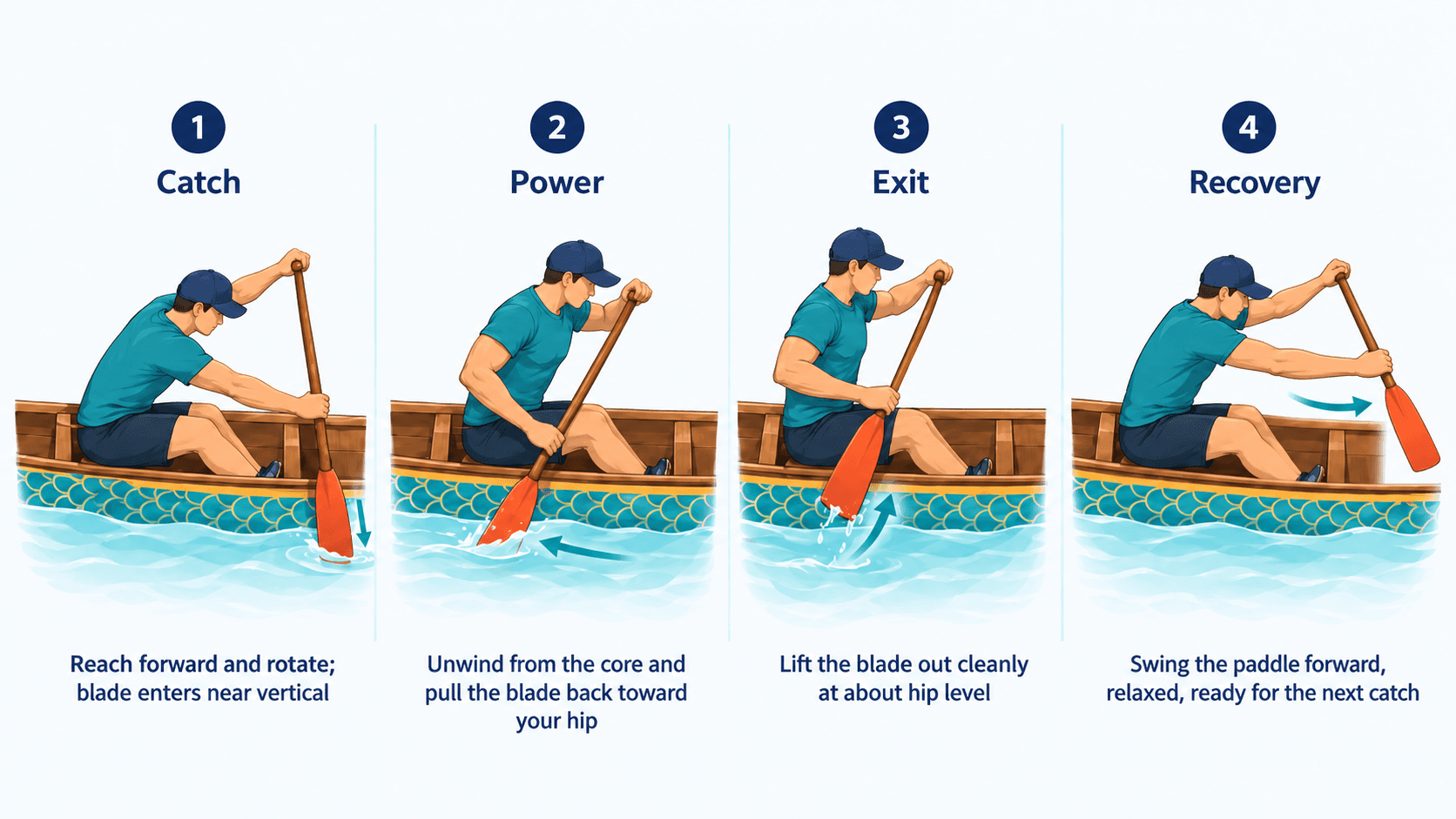
Every dragon boat stroke moves through four phases, repeated continuously:
1. The catch. The blade enters the water, ideally close to vertical, reaching forward from a rotated torso rather than just extended arms. This is the moment that sets up everything else: a clean, timely catch is the single biggest factor in a crew looking synchronized.
2. The power phase (or "pull"). The paddler drives the blade back through the water, generating forward force. The power here should come from the torso and core rotating back toward vertical (think of unwinding at the waist) rather than from pulling with the arms alone. Arm-dominant paddling fatigues quickly and produces far less force than engaging the bigger muscles of the core and back.
3. The exit. The blade lifts cleanly out of the water once it reaches roughly hip level, before it starts dragging or pushing water upward. A clean exit keeps the stroke efficient and sets up a smooth recovery.
4. The recovery. The paddle swings forward through the air back to the next catch. This should be relaxed, not rushed. A common beginner instinct is to hurry the recovery to "keep up," which actually throws off timing rather than fixing it.
Core Mechanics That Matter Most Early On
Rotate from the torso, not just the arms. New paddlers often try to generate power by pulling hard with their arms and shoulders. Watch experienced paddlers and you'll notice their whole upper body rotates with each stroke: the reach at the catch and the drive through the power phase both come from twisting at the core. This isn't just about power; it's also what protects your shoulders from overuse injury over a season of paddling.
Match the paddler in front of you, not the drummer directly. It's a common beginner assumption that you should paddle "to the drum," but in practice most crews time their stroke off the paddler directly in front of them, with the stroke seat (front row) setting the pace that the drummer reinforces. Watching the blade of the person ahead of you, rather than your own paddle, is usually the fastest way to lock into the crew's timing.
Blade angle at the catch. A paddle that enters the water at an angle rather than close to vertical wastes power pushing water sideways instead of pulling the boat forward. This is one of the first things a coach will typically correct, and it's worth paying conscious attention to in early sessions.
Why Synchronization Matters More Than Individual Power
This is probably the single most important concept for a new paddler to internalize: a crew paddling in perfect unison at moderate effort will consistently beat a crew paddling hard but out of time. Twenty paddlers pulling at slightly different moments don't add up to twenty times the force. Mistimed strokes actually work against each other: they catch air, catch water at different depths, and disrupt the boat's glide.
This is why coaches spend so much early-season time on timing drills rather than pure strength work, and why your first few sessions will likely focus more on "stay together" than "paddle harder." Trust that process: raw power becomes useful once the crew is synchronized, not before.
Common Beginner Mistakes
- Bracing/pulling with the arms instead of rotating the torso. This leads to quick fatigue and less power.
- Rushing the recovery to "catch up." This actually throws off timing further; it's better to reset smoothly at the next catch than to hurry.
- Watching your own paddle instead of the crew. This makes it hard to lock into the boat's collective rhythm.
- A shallow or angled catch. This wastes power and looks (and feels) rougher than a clean vertical entry.
- Tensing up under the drummer's tempo. New paddlers sometimes stiffen when the stroke rate increases; staying relaxed through faster strokes is a skill that comes with reps, not something to force.
What to Expect From Your First Few Sessions
Most new paddlers spend their first practices on flat-water drills focused purely on timing and basic form, often at a slow, controlled stroke rate before any race-pace work begins. It's normal to feel uncoordinated at first. Synchronizing with 19 other people you've never paddled with is a real skill, not something anyone picks up instantly. Progress in dragon boat technique tends to come in noticeable jumps once timing clicks, so don't judge your early sessions too harshly.
This is an introductory guide. For structured, progressive skill-building, including drills, conditioning, and race-pace preparation, see our Training page.