Dragon Boat Racing Rules Explained
If you're new to dragon boat racing, the rules can feel more confusing than they need to be, partly because the sport has two separate governing bodies running parallel World Championships. This page walks through the basics: how a crew is structured, how races are organized, what the equipment rules require, and why there are two competing "world championship" titles in the first place.
The Crew
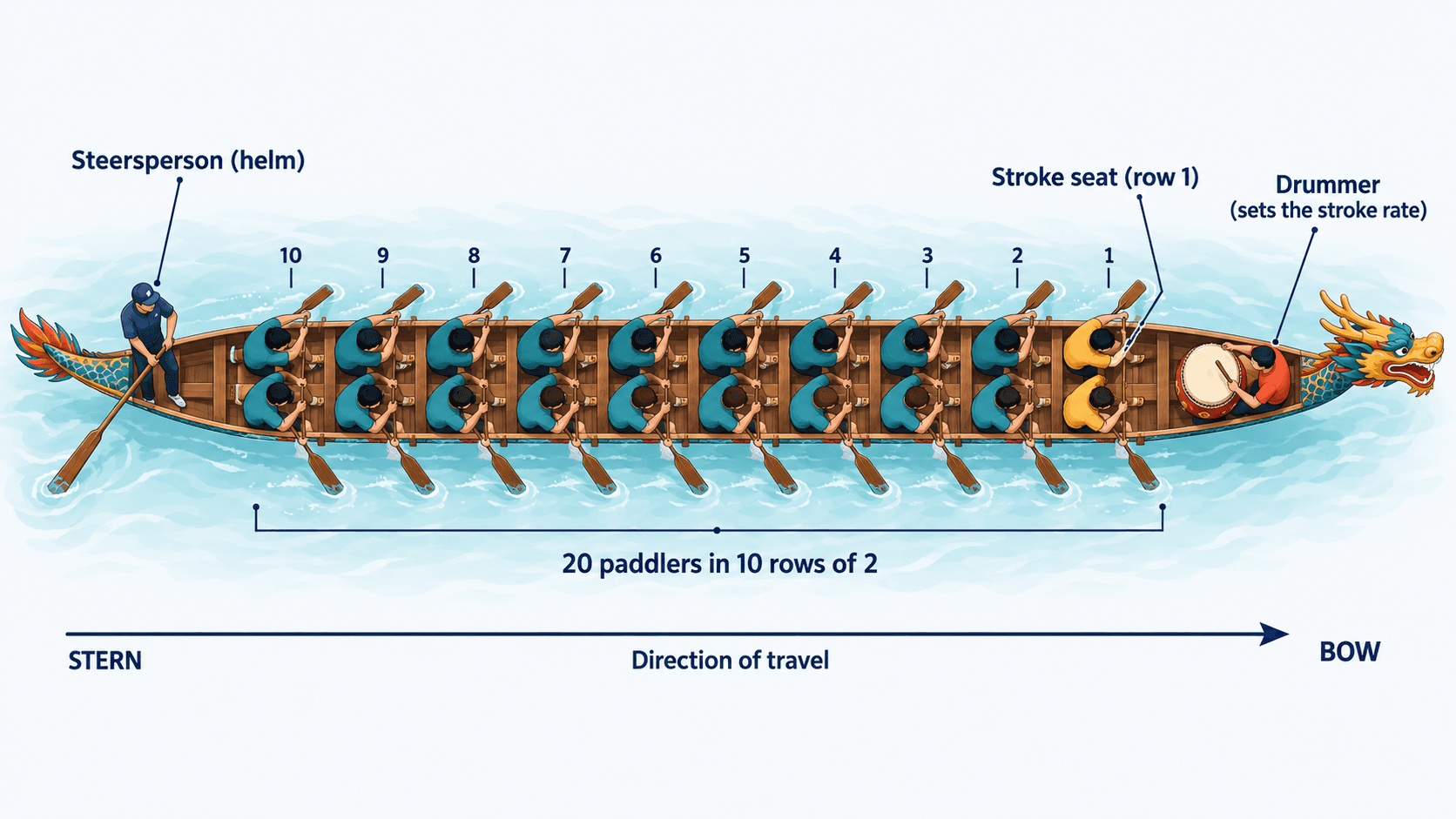
A standard competitive dragon boat crew is 22 people:
- 20 paddlers, seated in pairs across 10 rows
- 1 drummer, at the bow, who sets the stroke rate and keeps the crew synchronized
- 1 steersperson (or "helm"), standing at the stern with a steering oar, responsible for keeping the boat on course
Many events also race a "small boat" class of 12: 10 paddlers, 1 drummer, and 1 steersperson. Small boat racing is common at grassroots and charity festivals since it requires fewer participants per team and smaller boats.
Divisions
Crews are typically grouped by:
- Gender: Open (mixed-eligible men's/general), Women's, and Mixed (a set ratio of men to women on the boat, often close to even)
- Age: Junior categories (commonly under-18 and under-24), Senior, and Grand Master/Senior Master divisions for older paddlers
- Ability/purpose: Community and corporate divisions at festivals, competitive club divisions at regattas, and national team divisions at Championships
Breast cancer survivor (BCS) teams often race in their own dedicated division at festivals affiliated with the International Breast Cancer Paddlers' Commission (IBCPC), separate from the standard age/gender divisions.
Race Distances
Most competitive races are run over 200m, 500m, 1000m, or 2000m, straight-line sprints on flat water. Shorter distances (200m) reward explosive starts and power; longer distances (2000m) test pacing and endurance. Festival races are often shorter, informal distances chosen for spectator visibility rather than championship standardization.
Equipment Rules
Dragon boat racing is unusually specific about equipment, since standardized gear is what keeps competition fair across manufacturers:
- Paddles must meet IDBF Specification 202a, which fixes blade geometry and limits overall paddle length to roughly 105–130 cm (about 41–51 inches). Materials can vary (wood, fiberglass, carbon), but the shape cannot.
- Approved paddles carry an IDBF stamp. At sanctioned competitions, paddles without this approval mark are rejected during equipment inspection.
- Boats follow standardized hull dimensions and seating configurations so that no team gains an advantage from a non-standard vessel.
For casual and festival racing, equipment rules are often relaxed, so check with your specific event organizer rather than assuming championship-level rules apply.
Why Are There Two World Championships? IDBF vs. ICF
This is the single most confusing thing about dragon boat racing's structure, and no one explains it well, so here's the plain version.
The International Dragon Boat Federation (IDBF) was founded in Hong Kong in 1991 specifically to govern dragon boat racing as its own sport. It now counts more than 80 national federations as members and runs its own World Championships, Club Crew World Championships, and World Cup events. For most of the sport's modern history, the IDBF was the closest thing dragon boat racing had to a single global governing body.
The International Canoe Federation (ICF), the long-established governing body for canoe and kayak sports, separately adopted dragon boat racing as one of its disciplines. The ICF runs its own Dragon Boat World Championships (most recently in the Philippines in 2024) and was responsible for dragon boat's debut as an official medal sport at the World Games in 2025.
Neither organization absorbed the other. Both continue to run parallel "World Championship" events, use somewhat different rules and classification systems, and in some countries have separate national federations affiliated with each (for example, a country might have one national body under the IDBF and a different one under the ICF for canoe/kayak/dragon boat). This is a genuine quirk of how the sport grew: two credible organizations recognized dragon boat's potential independently, and the sport never consolidated under one banner the way most Olympic sports have.
What this means for you as a paddler or fan: if you see "World Champion" attached to a dragon boat team or athlete, it's worth checking which federation's championship they mean. It could be either, and both are legitimate within their own structure. For grassroots and festival racing, this distinction rarely matters; it becomes relevant mainly at the competitive/national team level.
New to These Terms?
If words like "stroke rate," "steersperson," or "catch" aren't familiar yet, check our full Terminology page before continuing. It covers all the vocabulary used throughout this site.
Sources: International Dragon Boat Federation (dragonboat.sport), International Canoe Federation, Wikipedia's entries on the International Dragon Boat Federation and Dragon Boat at the 2025 World Games, International Testing Agency (ita.sport).