The History of Dragon Boat Racing
Dragon boat racing is often described as one of the world's oldest team water sports, and unlike most "ancient" sports, it never stopped being practiced. What began as a ritual on the rivers of southern China over two thousand years ago is now raced in more than 80 countries, from Hong Kong's Victoria Harbour to lakes in Wisconsin and rivers in the English countryside.
Origins: Legend and Ritual
The most widely told origin story centers on Qu Yuan, a poet and statesman of the state of Chu during China's Warring States period (roughly 340–278 BCE). According to legend, Qu Yuan drowned himself in the Miluo River in protest of political corruption. Distraught villagers who admired him paddled out in boats to try to save him, beating drums and splashing their paddles in the water to scare away fish and evil spirits, and throwing rice dumplings (zongzi) into the river so the fish would eat the rice instead of his body.
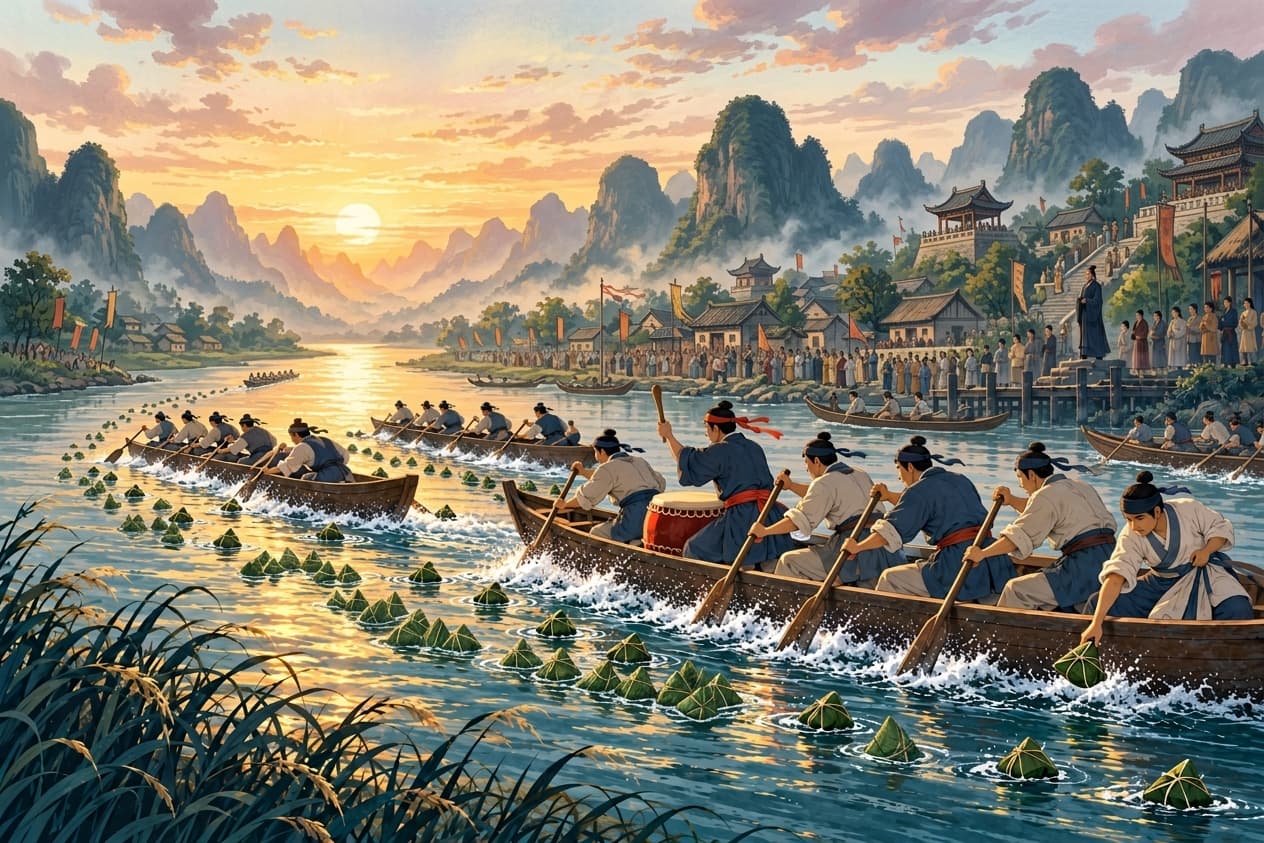
That act, racing boats out onto the water with drums pounding to honor Qu Yuan, is commemorated every year during the Duanwu Festival (Dragon Boat Festival), typically falling in late May or June on the lunar calendar. Zongzi are still eaten during the festival today, and the ritual "racing out to save Qu Yuan" is widely credited as the origin of competitive dragon boat racing.
It's worth noting that historians generally treat this as a legend layered onto older practices rather than a literal founding event. Dragon boat–style ceremonies honoring water deities and seeking protection from floods and drought appear to predate the Qu Yuan story in southern Chinese river culture. The Qu Yuan narrative became the dominant explanation over centuries because it gave the ritual a compelling human story, but the underlying practice is older than the legend itself: many people paddling a long, narrow boat to a drumbeat as a communal and spiritual act.
From Ritual to Sport
For most of its history, dragon boat racing remained a regional, seasonal tradition tied to the Duanwu Festival, a matter of community and ceremony rather than organized athletic competition. That began to change in the 20th century, particularly from the 1970s onward, as Hong Kong turned the traditional festival races into a more standardized, spectator-friendly competitive event, drawing international teams and media attention.
This modernization proved to be the turning point. What had been a localized cultural practice was reshaped into a format with standard boat dimensions, defined crew sizes, marked racing lanes, and timed heats, the same basic structure competitive dragon boat racing still uses today.
Going International
The sport's international governing body, the International Dragon Boat Federation (IDBF), was founded on 24 June 1991 in Hong Kong. Its creation marked dragon boat racing's formal transition from a collection of regional festival traditions into a codified international sport with shared rules, boat specifications, and a competitive calendar. Today the IDBF's membership spans more than 80 national federations across every populated continent.
Dragon boat racing's growth wasn't confined to a single governing body, however. The International Canoe Federation (ICF), the long-established governing body for canoe and kayak sports, also adopted dragon boat as a discipline, running its own World Championships and, in 2025, seeing dragon boat included as a medal sport at the World Games for the first time. This dual-governance structure (which we cover in detail on our IDBF vs. ICF explained page) is a quirk of the sport's rapid, somewhat decentralized growth: two respected organizations both recognized dragon boat's potential and built competitive structures around it, and neither ever fully absorbed the other.
A Sport That Became a Movement
Perhaps the most significant expansion of dragon boat racing in recent decades has nothing to do with elite competition at all. In 1996, Canadian sports medicine physician Dr. Don McKenzie launched a research study inviting breast cancer survivors to paddle a dragon boat, directly challenging the then-common medical advice that survivors should avoid repetitive upper-body exercise for fear of triggering lymphedema. The study's results, along with the powerful sense of community the participants reported, sparked what became a global movement.
That first team, Vancouver's "Abreast in a Boat," inspired the founding of breast cancer survivor ("BCS") paddling teams around the world. The International Breast Cancer Paddlers' Commission (IBCPC), now an associate member of the IDBF, coordinates a global festival held every four years; the 2026 edition in Aix-les-Bains, France, is expected to draw around 4,500 participants from more than 300 member teams across 37 countries. For many communities, breast cancer survivor teams are the most visible and active face of dragon boat racing. They are proof that a sport rooted in ancient ritual could become a source of healing and solidarity for people who had never held a paddle before their diagnosis.
Dragon Boat Racing Today
The sport now exists on a spectrum from grassroots to elite: local charity festivals raise money for causes with corporate and community teams racing for fun; club teams compete regionally and nationally; and national teams contest World Championships and, since 2025, the World Games. Standard competitive crews race boats holding 20 paddlers, a drummer, and a steersperson (with a smaller 10-paddler "small boat" class also common), over distances typically ranging from 200 to 2,000 meters.
What has remained constant across two thousand years is the essential character of the sport: many paddlers, one boat, one drumbeat, moving as a single unit. Whether it's raced by a national team chasing a World Championship medal, a corporate team at a summer festival, or a breast cancer survivor crew finding strength together on the water, that shared rhythm is what dragon boat racing has always been about.
Sources and further reading: International Dragon Boat Federation (dragonboat.sport), International Breast Cancer Paddlers' Commission (ibcpc.com), Wikipedia's entries on the International Dragon Boat Federation and Dragon Boat at the 2025 World Games.